
Address your F.E.A.R.
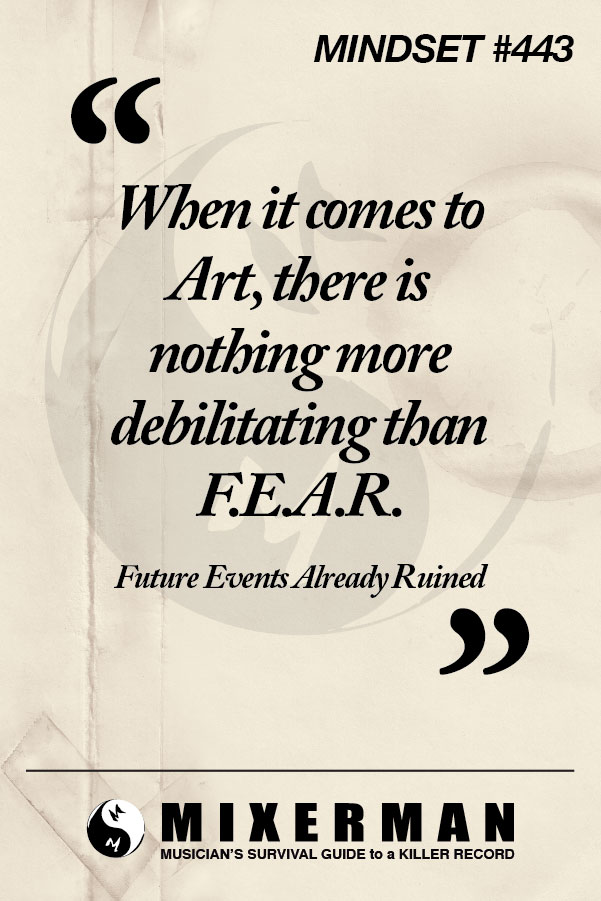 As a musician making your own record, it’s critical to understand fear. Really, it’s critical in any capacity, but especially so as record-makers. You can’t eradicate fear, it has a critical function in our lives. But we can certainly come up with strategies to help us bypass any fear that is preventing us from finishing our records. Fortunately, I address this particular kind of fear in my book MIXERMAN Musician’s Survival Guide to a Killer Record,
F.E.A.R.
Future Events Already Ruined
False Evidence Appearing Real
Fuck Everything And Run
When it comes to Art, there is nothing more debilitating than fear.
Fear is a constant motivation in our lives. Some fear is good as it helps to protect us from dangerous things. Like bears, for instance. It’s totally reasonable for me to fear a large Asheville bear staring at me through my open front door as I wake from slumber on my couch. I can tell you, 25 years in Los Angeles didn’t really prepare me for that.
Unfortunately, where it comes to a record, most fear is unfounded, overblown, and downright destructive. We all have to face fear in life. Fear of failure and fear of success are probably the most prevalent for us artistic types. They can be especially debilitating when they happen concurrently.
Ain’t that some shit? Fear of success concurrent with fear of failure? Who could make a record under those circumstances, let alone a Killer Record? 99 percent of all great performances are born from confidence. And this isn’t just about music. I’m talking about life too.
When you believe in yourself you operate without fear. When you operate without fear, you’re no longer getting in your own way. As a musician you have surely experienced this mindset. That solo that left the whole room gobsmacked? That was just a momentary burst of confidence in which you operated within yourself, without fear. If only we could summon that kind of confidence any time we needed it. We can. It’s just that sometimes our own brain will work against us.
When it comes to Art, fear often manifests as self-doubt, which is the most nebulous fear of them all as there’s rarely a specific outcome associated with it. To make matters worse, it all seems so rational at the time we go through it. The way I figure it, self-doubt is just an efficient way to beat ourselves up, as it’s the social contract of the Artist to be put down, and if others won’t step up to offer a lashing, then we must do it ourselves. Regardless of what you think about that theory, everyone goes through periods of self-doubt, even if it’s fleeting.
Exhaustion only serves to magnify self-doubt. It’s rather disconcerting to realize your record sucks while you’re in the middle of making it. But if the record isn’t finished, to proclaim it sucks would be a wholly unfair evaluation, as you don’t get to greatness without wading through the shit. Not everything you do will come out great. Which is why we don’t release everything we make.
A fellow writer friend once told me that, as an author, I must give myself permission to write badly. The reason for the permission? Because writing badly can’t be prevented, and I must push through those times to get to the moments where writing is effortless. And besides, there’s an editing process which allows me to address my bad writing, which is often far easier than dealing with a blank page.
Any work of Art in an unfinished state can only be judged on its potential, which is only realized upon its completion. Until the work is finished, it can’t be considered a work of Art.
When you listen to your unfinished work in total disarray–as your brain is over-saturated and hyper-sensitive and, thereby, wholly susceptible to self-doubt–this is about the time when you drop your forehead to your desk in exasperation, as you wonder why you ever thought to make a record in the first place.
My forehead has hit the desk in front of me more times than I care to admit. This is about the time I take a few days off. All of those problems that seemed insurmountable at the time are either not as bad as I thought, or easily rectified with a fresh perspective. Even if the ultimate decision is to undo or discard hours of fruitless work, that’s a normal part of the process when you build a record with intent. What’s important is that you don’t tear everything down at a time when you’re in a fragile state.
I always chuckle when people freak out about their record in the middle of the process. Is the record coming out tomorrow? Because that would be something to worry about. If you don’t waste some portion of your time on bad ideas, you’re playing it too safe. Bad ideas often lead to unintended greatness.
I have invested hundreds of hours on creative projects that I’ve chucked after completion. I’ve written 40,000 word documents that never saw the light of day. I’ve recorded entire songs that never made the album. Welcome to the world of Art. You try things, they don’t work, you move forward. The bottom line is, you’re not going to release your record until it’s right. So, there’s really no reason to freak out over its current state. It’s not done.
Early on in my mixing career, shortly after the success of Bizarre Ride II the Pharcyde, I would often take home a cassette reference of the day’s mixes. Cassettes were fraught with problems, and a slight misalignment of the heads between the record deck and the playback deck could result in a significant loss of high end. As a young mixer, I would bring home a cassette reference, only to plummet myself into self-doubt because the cassette lost much of the brilliance from the studio. Invariably, I would return to the studio the next day, only to realize all of my concerns were unfounded.
I went through this for way longer than I should have, and at some point I realized, cassette references were only good for one thing–losing sleep. They didn’t actually tell me much beyond the fact that I was highly susceptible to self-doubt. The best way to deal with that was to trust myself. Which seems odd. You can cure all self-doubt just by trusting yourself? Why, yes you can.
Rather than continue to bring home unreliable references, I stopped bringing them home at all. Even after purchasing a DAT player for home, it was rare for me to listen to mixes there. My time at home was best served away from the project. Not to immerse myself in it further after a full 12-hour day of obsessing. That required trusting myself.
Self-doubt, while destructive, does have its redeeming qualities. For starters, it can be quite useful for putting ego in check. Don’t mistake ego for confidence now. Ego and self-doubt are similar tonics in that ego provides us the elixir of confidence with the side effects of self-doubt. Good things rarely come from ego, as it is merely arrogance born out of conceit which either manifests itself through comparison or delusion. I’m better than you areis ego due to the comparison. I will make a Killer Recordis an expression of confidence as it puts the focus on self. I will make a Killer Record just like I always dois ego, because the conceit lies in your attempts to convince yourself that you’re infallible.
Whereas ego often puts the focus on others, confidence puts the focus on ourselves. Confidence is where we operate best. It’s just an insanely difficult headspace to maintain.
When you operate from a place of confidence, you’re doing, not thinking. And you’re certainly not concerned with what others might think. That’s a great place to be. Yes, you’re using your brain power to problem solve and that’s surely thinking. But you’re certainly not all wrapped up in yourself nor the analysis paralysis that goes along with overthinking matters.
When you’re confident, you don’t second-guess yourself. You don’t usurp your own power. You trust yourself, and you work assiduously towards a goal. In confidence, when something is right, you know it’s right. When something is wrong you know it’s wrong, and all you care about is fixing it. Really, what could be more efficient than that?
In sports, this is called being in the zone. It’s the point where your brain and your body are so in tune, that everything you’ve practiced for years becomes momentarily effortless and automatic. Once self-doubt seeps in, it’s over. You’re out of the zone.
Sadly, no matter how confident we might be in our abilities, and no matter how good we’ve become at maintaining our confidence, fear does still come into play. An outside trigger can instantly neutralize all of that hard work, and our worst thoughts can return in an instant. As much as I’d like to supply you with a foolproof method to harness fear in general, that will require an entire lifetime to achieve, and not even then. In other words, I’m still working on it myself. So, perhaps we should address some more specific fears, and try to break them down into their absurdities.
Do you fear that people will hate your record?
That’s going to happen regardless. There’s no such thing as a universally adored record, and if there was, I already hate it. Therefore, there’s no such thing as a universally adored record. You’re going to fear something that we can guarantee is going to happen anyway? Do you fear the sun rising? Because you won’t stop that either. People will hate your record, and more people will hate it than love it, and the same is true of every record ever made.
As I’ve already pointed out to you, our goal as an Artist is to cause a reaction. Really, it doesn’t matter what that reaction is, so long as it’s a strong one. The worst reaction is ambivalence, which is technically no reaction at all. It’s a non-reaction reaction in which your work generates nothing more than a yawn. As much as it can be unpleasant to be told how bad you suck, at least you moved someone enough to care.
Do you fear writing a bad song?
It doesn’t take long before any songwriter realizes they’re playing a numbers game. Most of us record our good songs and let our bad songs fade away from our consciousness. Some of you may record everything that you write as a live to 2-track demo, which is great. But your records themselves should be confined to your stand-out songs. These days there’s little room for filler material given the strange slow death of the album as an artform.
Oddly, you’re more likely to fear producing a bad record than you are to fear writing a bad song, despite your song being of supreme importance and the production nothing more than a delivery medium. Much of that has to do with confidence. You believe in your ability to write a great song. You like your songs, or at least some of them, which is why you wish to document them. Therefore, it’s easy to be confident about them. Your recordings, on the other hand, might not come out the way you intend, and that’s going to create self-doubt.
Let me ask you this. Was your first song your best song? Or did you have to write a bunch of songs before you really started to get good at it? Why would it be any different for recording your song? Why would you be good at recording the first time out? Why would you be good at recording the tenth time out for that matter?
You didn’t pick up your musical instrument for the first time and play it like a champ. You had to learn scales and chords, and to read musical notation. You had to practice for hours upon hours merely to achieve incremental improvement. Even if you learned to play an instrument by ear, there was still lots and lots of practice involved.
The difference is, of course, aside from perhaps your mother, the world didn’t have to sit through all of your awful practice sessions. Yet, once you complete your record, the first thing many of you will do is put it up on the Internet. And you’re going to put it on the Internet for the same reason you were so excited to record it. Because you think the song is amazing. Which is exactly the reason why you should put it on the Internet.
All that matters are your songs. Those are yours forever. The songs have potential value in the future. Your recordings have none and can be redone. If one of your songs becomes popular, it will be recorded tens of thousands of times by others, and the predominance of those records will be awful renditions of your song. People will still love the song. And if you happen to record the first horrendous version of your own song? That’s okay too. A lousy recording is nothing to fear. It’s the song that must stand the test of time.
Enjoy, Mixerman
 Get your copy of MIXERMAN Musician’s Survival Guide to a Killer Record
Paperback or Kindle
Audiobook