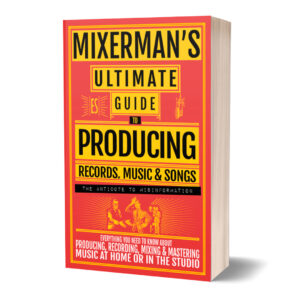
MIXERMAN’S Ultimate Guide to PRODUCING Records, Music & Songs
BIG NEWS! Mixerman’s Ultimate Guide to Producing Records, Music & Songs is HERE!
The subtitle: Everything You Need to Know About Producing, Recording, Mixing & Mastering Music at Home or in the Studio
Producers, engineers, musicians—this is the guide you’ve been waiting for! My latest book, Mixerman’s Ultimate Guide to Producing Records, Music & Songs, is packed with real-world strategies and insights from my decades in the industry.”
I’m pre-selling the book right now on Indiegogo. Please check out my campaign, and order your copy(ies) before it ends and the price goes up!
👀 Watch the video below to learn more! 🎥👇
Tell Me More!
MIXERMAN’S Ultimate Guide to PRODUCING Records, Music & Songs began as a revision of Zen and the Art of Producing (2012), which primarily addressed the for-hire producer working out of rented studios. But even I don’t make records like that anymore. Sure, I’ll book a studio for drums on a band project or to track a horn section, but the majority of my producing work now happens at home. As such, my original producing book seemed more like a throwback to another time. It was also written for what is now an impossibly niche audience. I couldn’t revise my way out of this. I had to completely overhaul and expand the work, conceptually and structurally.
Once I’d made the decision to significantly broaden the scope of the book, it was clear I’d need months of intense focus in order to write, revise, and organize it. I would have to greatly limit the number of projects I’d take on as I did. So, I sought sponsorships from companies whose products I use every day in my work—ones that would make any producer’s life easier, regardless of skill level. LEWITT, FabFilter, and IK Multimedia all stepped up with sponsorship funding, and I am greatly appreciative for their support.
The organization of this book was the most challenging part. Producing music isn’t a linear process, nor is it learned in a linear manner. It’s far more circular in nature. Further complicating matters, every one of you reading this, comes with your own unique knowledge base and experience level.
How do you organize interdependent processes—each affecting the other—for an audience with vastly different levels of experience, all in a linear manner? I can answer that. You don’t. And you can’t. At least I couldn’t. What comes out resembles more of a zig zag, where at times, one concept, which may seem completely unrelated, comes out of another. “may seem” being the operative phrase here.
If you’ve read any of my other books, you’ll know that I sometimes enter into massive digressions, to the point that I even call them out as such. I always thought that was just my style—perhaps to some degree it is—but now that I’ve tried to organize this much information into one exhaustive resource, I now understand the crux of the issue. Everything affects everything else where it comes to producing music, and it all relates to manipulating emotions through sound.
Despite its importance, you won’t find a dedicated “Sound Design” section in this book—because everything you do affects the sound. Every decision—your arrangement, recording choices, the quality of performances, how you think about space, instrumentation, and musical function, how (and why) you use processors and plugins, how you apply motion and shape distortion, even your approach to artistic refinement—all of it is sound design. It’s all so deeply intertwined that by the time you reach the Mixing & Mastering chapter, you’ll already have everything you need to set you up for a great mix.
I structured MIXERMAN’S Ultimate Guide to PRODUCING Records, Music & Songs in a way that allows producers at nearly any level to follow along. That said, you might occasionally come across a term before I’ve had the chance to fully flush it out. This was unavoidable. Had I stopped to define every technical term the moment it appeared, this book would be unreadable. So if you run into something unfamiliar, look it up—factual information is just a quick search away.
Of course, the factual technical information isn’t what sets this book apart. Anyone who has experience engineering music for enough time can relay that to you. My early books barely touched on it. The musical and practical decisions that shaped a record were of far more value than understanding the technical ones, and that’s why my books addressed.
In my first version of Zen and the Art of Mixing, I don’t even talk about how to control a compressor. Which may seem baffling, but learning how to use a compressor really just requires some practice. In the early part of my career, I was mixing records on a daily basis, including gold ones, yet I couldn’t have described to you specifically how to control a compressor. I just twisted knobs aggressively until I heard something I liked. And if that didn’t work? I’d try something else.
In fact, I wore my lack of technical expertise as a badge of honor. My processing tools were not technical instruments to me, but rather musical ones designed to be pushed well beyond their limits. I wanted to break them in the process. I couldn’t care less what those timid engineer-types considered optimal. Frankly, I took offense to being called an engineer. Mixer! I would admonish.
As far as I was concerned, I was an Artist, just like the Artists and Producers who hired me. The gear was merely there for me to mangle and control the sound. I made my decisions purely by ear, often relying on hit-or-miss strategies.
Over time, of course, I figured out what all the knobs did and how the controls worked. When I transitioned fully to digital—which was far less forgiving than analog at the time—I was almost forced to learn the technicalities. And while that knowledge gave me more control and at times made the process more efficient, it certainly didn’t make me a better mixer or producer. It just made me more purposeful, more often.
Worry not—I can, and do, explain how to control our most important processors, breaking down the technical side in a way that’s easy to understand and digest. It’s the technical considerations that trip people up, especially in a world where mentoring has gone to die, and bad information is spread around online like the plague. That’s why this guide is so comprehensive—because you need reliable, accurate technical knowledge.
But make no mistake—the real value lies in my perspective.
MIXERMAN’S Ultimate Guide to PRODUCING Records, Music & Songs comes from my unique perspective as a successful professional music-maker with a diverse discography—one that spans decades of technological change, which directly shapes musical trends. I don’t just explain how to produce, but why certain decisions matter. And not just why I make certain decisions, but why you might make certain decisions—whether musical, technical, organizational, monetary, or even political in nature. All of it based on real-world practicalities. That’s the good stuff. There is information and insight in this guide that you will not find any-where else.
I will often offer you my preferences to go along with my explanations, all of them based on strategy within the context of musical decisions. There is no strategy that works for all people in all situations. There is only the strategy that best fits the moment, the music, the talent, the goals, and your preferences. Over time you’ll develop your own strategies, based on your own experiences and needs. You may even reject my advice at times, which you should. That’s one of the more effective ways for you to eventually realize I’m right.
Ahem.
There is no technique in producing music that could be considered invalid. If it works, it works. As such, you’ll get my opinions, but you’ll find very little dogma on my part. I seek to arm you with strategies to help you achieve your vision, so that you can create music and songs with intent, exactly as you hear it.
Ultimately, music is meant to evoke feelings from great songs. There is no right or wrong where it comes to the creation of art. There is only your intent, how easily you express that intent, and how you use it to connect with an audience. Nothing else matters.
This book addresses everyone from the semi-beginner producing their own songs all the way to the more seasoned for-hire producer who wants to level up their game. I’ve discussed everything I could think of—so that you can work in an effective and creative manner, whether you do everything yourself at home, or manage a team in the studio.
NOW AVAILABLE!
Paperback
eBook
Also check out The Daily Adventures of Mixerman podcast! Free! It’s an audio extravaganza!